Longform: On Writing Scenarios
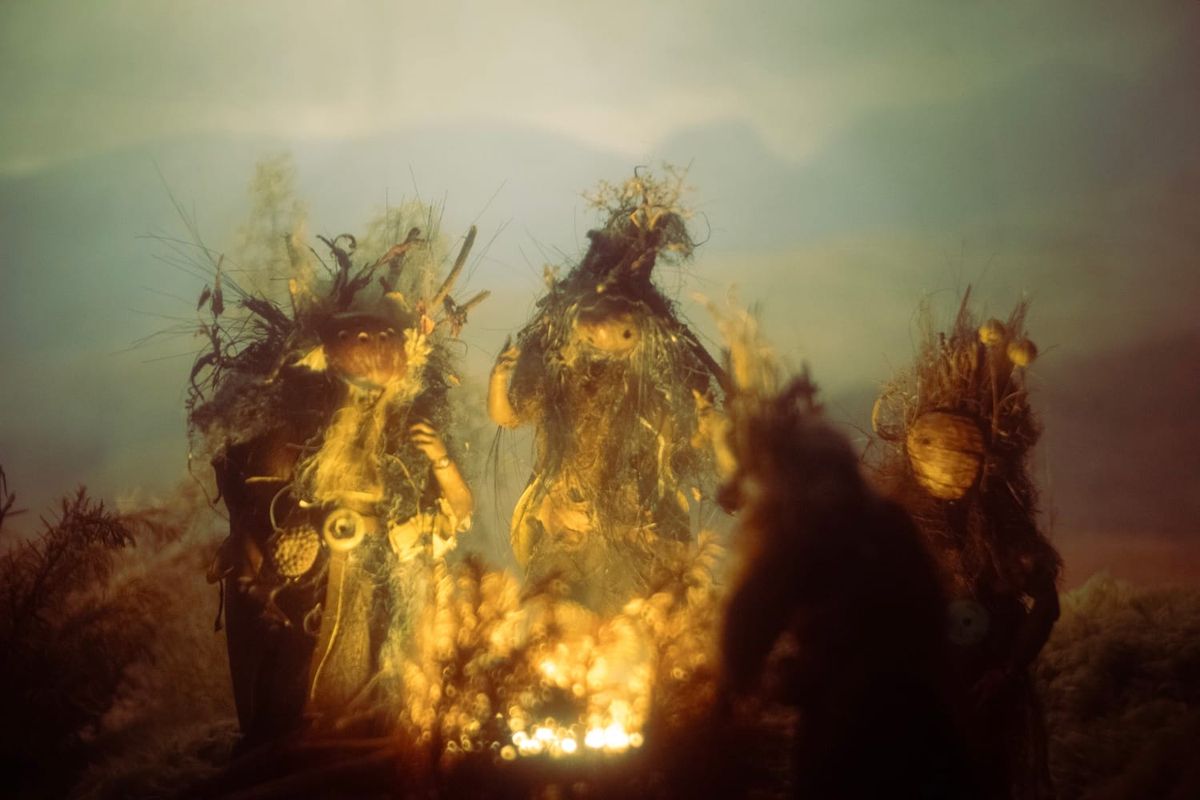
I’ve been asked a few times to write some material about designing games and writing scenarios, and I’ve been somewhat reluctant to do that, beyond what is already here. A lot of the real nitty gritty of the process is quite obscure to me, even as I perform it for publication across decades. I am loathe to produce something that’s purely performative and doesn’t get into the real stuff: where do ideas come from, how do ideas get made into actual manuscripts? I find it hard to give satisfying answers in the style I think people want. I'm also wary around notions of authority.
Just recently I’ve been thinking about trying to document those more obscure processes more thoroughly, so I have been watching myself while I work. That’s not normally something I do, but it turns out it’s possible. So here are some recent examples of working on a scenario for Maskwitches, which pointed me towards some thinking about how I work.
Really, this is a lot of words surrounding a small thing that happens: making a connection between things I've found and collected. But it seems to need a lot of words because it's about everything I do.
My starting point here was “I need a scenario for Maskwitches”. In fact I needed three for the Maskwitches GM’s Companion. That was quite an urgent and pressing need, but one I really wanted to deliver.
This underlying pressure-plus-desire is really important. I am lucky in that I can do a lot of things, so having a clear reason to do any particular thing helps ensure it gets done. I get easily distracted and tend to work on a lot of things at once to keep boredom at bay. That’s something I definitely have to proactively manage: I run a company as well as being a creator, so also having a low boredom threshold can be tricky.
Equally, the landscape of projects within Handiwork Games can be quite complex. Maskwitches is unique in that I do most of it, and I don’t need to involve many other people to make a book. Paul does layout, I’ll involve an editor and proofreader like Jessica. But most of the work is just me, which makes it low hanging fruit in some ways.
That low headcount makes it easier to talk about, without getting into the dynamics of teams and working with other people. This piece will be quite long and rambling, but purposefully so? I don’t think brevity really covers what I want to say, in the way I want to say it. I also understand not everyone wants to read longform pieces.
So. Thoughts on writing scenarios. These are of course my own thoughts and methods, and I don't offer them up an evangelical or polemical way. Land on your own moon. You might find something of use here, and I hope you do, but there's no problem if it presents the complete opposite of your own working method. You could write your own blog post about that! I'm in no way trying to convince here. Just to observe my own process.
Where to start
My first port of call is a mixture of philosophical and structural.
Philosophical: What is Maskwitches about? What sort of themes are supposed to be presented here? What do I want to say here? I don’t need to know the final answer, but having an answer to get me moving is a good start.
Structural: how does a Maskwitches scenario work in particular? What does it need? Different games have different structural needs, and it’s good to remind myself of this information so that the philosophical stuff stays on target. I’ve edited a lot of scenarios in my time, especially for The One Ring RPG, which did not consider this point in their first drafts. While it’s lovely to ruminate on unseen forces within Middle-earth, or give characters lengthy backstories that key into ages of the world which cannot be included in licensed material and thereby “cleverly” access them via the back door, that’s not the gig. We don’t include things that the players can never see, or which don’t benefit the GM’s understanding for this scenario. I don’t think we have to be overly rigid about this, and not everything must always be relevant to what will appear on stage - the framework behind the scenery matters too, and GM enjoyment is also a thing - but it is something I want to be mindful of, in the name of being disciplined and working on things that can be used.
Through practice I don’t need to think too hard about these things, and I move with a light touch. Getting going is often more important than precision. But I do want to make directed, purposeful work.
As an example, it’s extremely optional within the game of Maskwitches whether the game is about “what it means to be a maskwitch”. That could be seen as more of a plot for a novel or comic than a scenario for this game. The players bring all that stuff to the table, and it doesn’t really work to push it at them through a scenario. So those kinds of ideas are quickly discarded. Contrast that with BEOWULF where “what it means to be a hero” is a far better theme. We can use that very nicely to guide what we create, constantly checking with that core theme. The structure of the game is different, and the needs of its scenarios are different. We can push that theme out towards the singular player of a BEOWULF game much more easily and appropriately than in Maskwitches, where the players have a lot more narrative control. Having a good understanding of the game you’re writing for is really important, and through my career I’ve been surprised how often it is not understood.
Detail 1: eutrophication
Once I’ve defined this kind of space, I can think about some details. In this example we’re talking about Maskwitches, which can be quite freeform. The scenarios really boil down to providing interesting and inspirational riffs on the core “things” from the setting.
We need a problem that the hunter gatherer community are facing, and an evil spirit which has been spawned as a result.
All the time I’m gleaning stuff from the world around me. I’d been thinking a bit about eutrophication. That’s the process where algae and plant life in a body of water undergoes accelerated growth, and chokes all other life in that water. I’ve known about this for years - I used to read Nature magazine as a teenager, and it had come up on a school exam the week I’d read a massive article about it, which was lucky, and so stuck with me.
Decades later I’d made some gaming tokens which looked like algae blooms, so it was again on my mind.
I also then (in the course of voraciously reading) came across an academic paper about eutrophication in the Mesolithic period (which is when Maskwitches was set).
It’s thought that some hunters burning plants close to bodies of water has inadvertently caused eutrophication by fertilising the water with all the ash from the burning. Huh. That’s interesting, right?
So that was kicking around in my head for a few weeks, and it kept coming up. I try to stay alert to things being shown to me. I don’t believe in anything spooky, but it feels fairly certain that patterns exist, and following them seems to bear fruit.
Detail 2: status
I’d also been writing another section in the book about what normal people do all day in the Mesolithic, and a little bit about status in hunter gatherer societies. This is something I find fascinating, and which I’ve read a fair bit about. This time I’d read about how in one hunter gatherer society, younger hunters who take down large prey traditionally have to pretend they were unsuccessful, and speak in coded language to indicate to an older hunter where the carcass is stashed. That way no one gets too big for their boots - which is something that many hunter gatherer societies care deeply about. They have flat social hierarchies and they’re maintained with traditions like this. Which is sorta interesting in the age of Trump and Musk. The hunter gatherers are on to something, eh? When people get too much, and get too full of themselves, it’s disastrous. We know this in our own cultures. We just don’t seem to do much about it.
So that theme was also floating around in my mental soup. I couldn’t begin to catalogue all the stuff that’s in there, and if there’s one take away from this essay it’s: be interested in things. Lots of things, across a broad base. Don’t keep drinking exclusively from the traditional nerd wells of genre stuff. Go elsewhere too. If you want to make interesting and unusual things, you need to seek out interesting and unusual things. And remember interest comes from you. You choose it, and practice it. Banish cynicism from your creative practice. I’m phenomenally cynical in my personal life, but not in creative work. You have to preserve that child-like joy in everything to really make the good stuff.
So I have a couple of ideas of what this scenario could be about: eutrophication in the Mesolithic and the traditional policing of status between individuals.
Connective tissue
How can I link the two becomes the question. And that in itself isn’t too hard. We want a social problem - so some hunters have broken the taboo on egotism, and they’re being directly competitive, seeking to out do one another, to the detriment of the community as a whole. This is way outside of cultural norms in the setting, and a good example of what might cause a spirit to be spawned, a situation which the characters will have to resolve.
So those hunters have been burning excessively to clear space for green shoots that bring deer out of the woods. But as a result they’ve caused a nearby lake to bloom with algae and all the fish and fresh water shellfish are dying. This has caused an ancient fish spirit to leave the water and is now stomping/slithering/creeping around eating people. Cool. Well, not cool for the people getting eaten by a fish monster but cool for the scenario.
This is somewhat unusual for a Maskwitches scenario in that there’s a scientific rationale behind the problem. I don’t normally need/bother with that, but hey. It’s all good. We can go there.
I did however spend a bit of time checking that this makes sense, and that the needs of a scenario follow from the events. Is really the issue over fertilisation of the water, which is more the fault of… chemistry, rather than people? In a way is the evil spirit too much of unnecessary addition? Is the problem the removal of a food source, and they need to just stop the burning. Not hunt down an evil spirit? And I conclude it’s all fine. The evil spirit is necessary for player engagement and basically: it’s fun? It makes a pre-agricultural land management issue into an adventure and a fantasy story. Good.
It also means that if an environmental scientist plays the scenario they don’t instantly “solve it”, and it gives us a nice fictional/magical buffer on hardish science. I also need to be sure that a scientific theory phenomenon couched in modern language translates into the setting and can be revealed to the players' characters within the setting. That all checks out, and I have my core “plot” as it were. I do have to be prepared to rework or entirely bin an idea that doesn't meet those criteria, and it is good practice to learn to do this lightly and quickly.
Allegory and punching the reader on the nose
From this I can hang the character of the two hunters. If I want to I could go satirical and weave into them some clues that they represent things from our modern world. I consider this, but drop it. The inferences are already there throughout Maskwitches, if anyone cares to look. I never announce it, I never tell the reader what it is.
A customer once came up to me at a convention booth, having spotted the Maskwitches core book, and asked “Masking? Changing your powers by changing your outward appearance? Is this game about…” and I interrupted to say “yes” as quickly as I could. Yes, it is about those things. I never say it out loud. That’s for the player or reader to uncover, and think about for themselves. I have complex feelings about both identity and the environment which play out in Maskwitches. My explanation of those ideas is… Maskwitches. That’s the text I made about those things. There isn’t a tldr version which doesn’t lose the nature of itself in being made.
In the last few years I’ve seen some games “about” genuinely worthy political ideas, and they’re so painfully on the nose that they become clumsy polemics. That’s the opposite of what I want to do. I want to ask more of the reader/player and I think the experience is better for it. In this I’m influenced by a couple of things, which are perhaps surprising bedfellows.
Tolkien is one. His fiercely accurate language around allegory lands hard with me. His work is clearly about things. But it’s not lumpen allegory. You won’t find a 1:1 analogy in his work. There is space for the reader to bring their own things to it. And that’s why it works. To me this is even more important when we’re writing gaming scenarios which must have space for the players to bring their choices and stances to the work.
The other factor in my feelings on this is my fine art education. Terms used in art criticism like “literal” and “arbitrary”, even “illustration” in that context, have stuck with me.
I was at art school in the 90s, so was fed Derrida and Foucault, to some degree against my will. I have my own enduring issues with the relevance of semiotics, but there’s still utility in that model at a basic level. Stated in very basic terms, the idea that what’s meant, what’s said, and what’s heard are three different things, has a use. It’s a framework to understand things, and it is relevant here. I think this is a useful way to think about RPG scenarios, and the way they're delivered from my keyboard to players via the GM.
When making art/doing cultural production, I don't believe that we get to just state our intention and assume that is the same as the end result. We don’t get to entirely determine what our work is about: it's much more of a conversation and collaboration than that. This is especially true for RPGs.
And hey. I certainly don’t think you need all “this stuff” to write RPG adventures. I think you could find just as much utility in transferable skills and ways of seeing that come from carpentry as can come from the study of fine art and the collapse of philosophy and art into one another in the 1970s. You’ll probably be a happier person to boot.
The idea of transferable skills and ways of seeing is really important to my work. We can read about one thing and apply the principles to another - essentially synthesis. Looking at the world around us with fierce curiosity, and remixing things to make new things.
When people ask “where do you get your ideas from?”, I’ve tried to move on from the cliché of thinking that question is a cliché. It’s actually a good question, and I sometimes wish creators would stop being so basic in rolling their eyes at it. I do this myself sometimes and I want to try to stop. It’s shorthand for resisting a shallow interrogation of art, but it comes with its own mean-spirited baggage.
The answer for me is: synthesis. Being able to synthesise information, to recombine it, to take things apart and put them back together as new things is the main skill in operation, and its one which can be practiced and cultivated.
We don’t “get ideas”. We go out and find things, and then we recombine aspects we’ve identified into new forms. It’s not a bad thing to ask that question - "where do you get your ideas from?” but it does contain several misunderstandings about the work and ideas, which I feel can be usefully unpacked if you're prepared to take the time.
That was quite a diversion. I don’t think I can talk about just the practical steps of making a thing without that philosophical stuff being present. It’s too integral to it, and it’s been too hard won, and too significant a part of my life and practice to just leave out. It matters to me, while I also know it can easily be seen as pretentious. Again - that makes no odds to me. It’s complex, not pretentious. It’s not pretending to be something - I understand it as real. But let’s get back to practicality and my working example.
Now I have my core idea for this scenario, as required by the game. And we know we’re not going to get too allegorical about it. Let’s allow players space to get into that if they choose. We can set up the potential for it, without paying it off. Let the players generate their own pay off that is relevant to them and their interests.
Next I need a series of set pieces: locations, characters, events, objects and adversaries to flesh out what the players might encounter as they start to investigate.
I can now go pretty freestyle. Anything I come across in my reading, my walking, my conversations with other creators can all spark ideas to go in, and I keep notes in one place. Just fragments is fine - I know that even if I forget what sparked me to write the thing down, or I misinterpret it later? Doesn’t matter.
Maskwitches is helpful to the scenario writer because there are a specific selection of activities which players undertake. So offering the GM “stuff” with which to respond to those activities means I have structure to order my random findings.
As well as keeping engaged in the world around me, I have a backlog of stuff to dip into - precisely like the eutrophication article from Nature magazine in 1989. I have a good memory for things that interest me, and nothing is ever wasted in finding things interesting.
Reverse Scripting
Alongside this foraging/beach combing ethos is the idea of reverse scripting. I don’t think I have room to write about that here, but I have an essay about it in Goodman Games book on scenario writing: How to Write Even Better Adventures.
In short, I consider feelings I would like players to experience at the table at a given moment. Triumph, joy, sadness, vexation, and so on. How might that manifest in the scenario? And then work backwards, reducing those flowers back to seeds, and placing them throughout the work. It’s building potential again. Offer a hammer here, a nail there, and you have a good chance of the players enjoying banging in some nails. Of course we have to as ever leave space for the players and their choices. We’re suggesting, we’re setting up dominoes that offer a variety of outcomes.
That’s a good example of a working practice that helps me with the notion of “getting ideas”. I’m not working in a vacuum when I have models like this to inform and structure what I’m doing.
The reverse scripting model, of thinking about the outcome of the intended feelings first, really helps balance and order the foraging method of collecting interesting stuff. I don’t want to present just “stuff”, as useful as that can be. An emotional through-line also matters.
I do tend to find that comes later, and collecting the stuff and then editing it into shape with the connections between the stuff works for me.
Fragments
In my fragmentary notes for this scenario I’d written the following notes, across several weeks:
Witch activities included in this one:
Consult the people
Craft a witch knife
Create a mask
Consult the elder witch
What’s going on?
Two hunters have fallen into a strong egotistical rivalry at odds with the normal way of life. Consequences. The trouble with young men?
Fragments
The birds fight the fish
The elder witch is a floating stone
The witch knife is made of gold, grains and nuggets from a river
The mask is an antler frontlet, Starr Carr
These notes live on my phone, and I add to them continually. Sometimes I make connections.
A really clear example of how I tend to work is in creating the witch knife activity for this scenario. I knew I wanted the activity of “crafting a witch knife” to be part of it. Players love a witch knife, since it lets you cheat a little bit in the final battle with the spirit. And it’s a great set of visuals - you gather the materials, you craft the knife, and then it’s produced with a flourish in the final battle and it all pays off as the players get to skip a stage.
In thinking about witch knives, I know I’ve previously used meteorite iron and bog iron, and it’s an important responsibility to provide GMs (and indeed players) with fresh ideas. So I did a little internet searching on early metallurgy. (It’s a deliberate magical anachronism in Maskwitches - the idea that this mystical order of ghost busting social workers knows the secret of working metal thousands of years before they really should, and they’re not sharing it.)
When I search for material online lately I’ve found it’s good to avoid Google with its mandatory AI summary. It’s often misleading and incorrect, and who needs that seeping into their work? So I’ve set my search engine default to DuckDuckGo, which at least lets me opt out of the AI summaries. When I’m searching the internet, I want to find interesting articles, and be able to assess their relevance and credibility, not have a machine tell me incorrectly what they say. I’ll do the incorrect interpretations around here, thanks!
I’m always open to finding something I didn’t expect or following a rabbit hole to make more fragmentary notes, or learn of a new book I need to read. And for that I need the original sources, not a summary that purposefully removes them.
On this occasion I was reminded that early metal work of course used softer metals like copper and gold, which were thought initially to be hammered cold. Ok that’s cool. So where might we find the raw materials? Copper production feels too industrialised (he says, having previously allowed witches to refine iron ore, for goodness sake. They use magic mushrooms to alter their perceptions rather than the metal, none of it is real, it’s fine), so I think about gold for this scenario.
You can find grains of gold in rivers, and that could be a nice activity for witches. I can imagine that scene. Sparkling grains found with the help of psilocybin er I mean “witch foods” leading to a larger nugget upstream? But then I check my fragments. “the birds blah blah” and there it is: the birds! The birds would be able to collect grains of gold.
So how do we get to that scene? What do “the birds” want in order to collect gold for the witches? Who even are “the birds” in this instance? What’s their story? Big river birds like herons? Little overlooked birds like finches? What about a morphic field of birds acting as a group intelligence? Imagine a shifting cloud of finches picking gold grains from a river in a second…
This is the sort of mental meander I go on. I’ll play out a lot of scenes in my noggin and pick the most “Maskwitches” ones for the scenario. I’ll remember some of what doesn’t make it in, and it’ll come back later in something else.
I do a lot of asking questions. Build a scene and then interrogate it.
As well as imagining these fragmentary mini-movies, I need to again be aware that player agency is important. We can’t get carried away with making a broadcast. We need the scenario to receive and respond to player generated information too.
We certainly can have that scene of a cloud of sparrows gleaning grains of gold, but we need to build in space for the actions of the players to get there. We need to make their choices in getting to it of prime importance, and offer interesting pathways to that moment. Personally I don’t have any issue with these kinds of fixed nodes, which will definitely play out in a scenario, provided we’re making the routes to them interesting and engaging, and just as important as playing some mini movie we thought up. The scenes we want to include let us ask the question “how do we get there?” And that’s included in the scenario itself. That’s the question the GM is asking the players.
The quality and nature of those potential set pieces creates that drive to get there in the players. When we’re doing it the right way, we come as close as it is possible to come to “it writes itself”. We’re filling in the blanks, in ways that promote the players doing the same at the table.
The important point here, in terms of writing scenarios, is that sudden connection between fragments in my notes. It can happen very quickly and without warning. I suspect it is possible to foster an environment which makes that moment more easy to stumble into, but that’s probably a different essay. We can certainly set things up to work this way, and the structure around what I do really helps. Knowing what the targets are, and why I’m trying to hit them really helps.
My basic method to achieve that is collecting things, and then connecting things, to make a new thing. That’s really the process, whether it’s providing me with moment to moment happenings in the scenario, or helping me to find an emotional through-line, or uncovering the themes which the scenario is actually about. It is also true of decades of art making. In a sense it’s all the same process. Leaving space for an audience, while doing the leg work of collecting interesting things to engage them.
Gather, imagine, and connect, over and over. There’s less having ideas so much as finding ideas. They don’t come to me, I go to them. In some senses, reading this over, we’ve come to an abrupt ending. But we’re there. This is what I wanted to say, and I’ve said it.
This has been useful to write down, because I suspect it’s something of an onion skin peeling back. There’s another layer underneath - how do I know what is “interesting”? How do I curate what is “more Maskwitches” and what is “less”? Those are interesting questions for another time.